
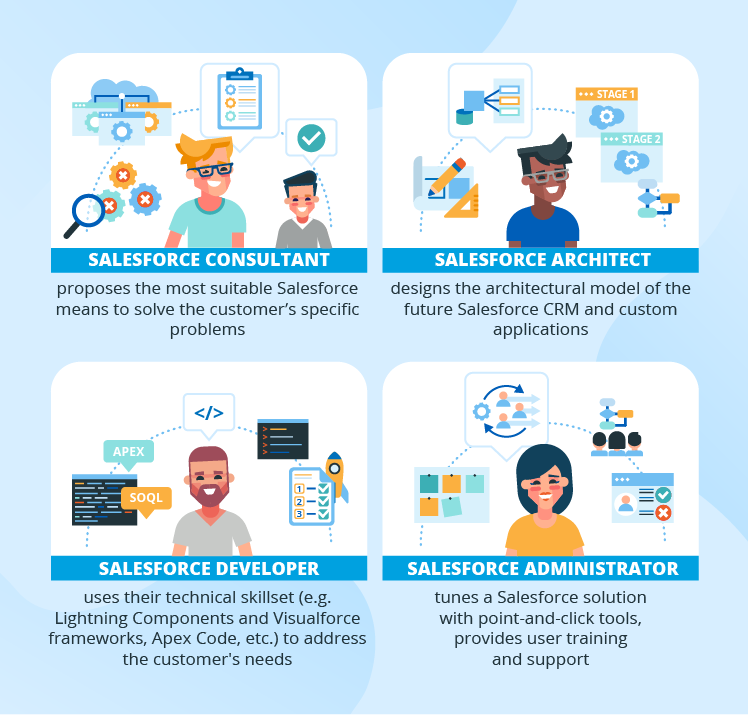
In today’s competitive landscape, businesses rely on Salesforce to manage customers, sales, service, and operations. However, out-of-the-box Salesforce capabilities rarely match your unique workflows, data models, and growth ambitions. Custom Salesforce development creates a tailored platform that fits your organization like a glove, enabling you to automate processes, unify systems, and extract actionable insights. By investing in a scalable, well-governed solution, teams move faster, collaborate more effectively, and deliver consistent customer experiences at scale. The result is not just a software upgrade, but a strategic capability that drives sustainable growth.
- Tailored workflows that map to your exact sales cycleGeneric configurations force teams to adapt to software instead of the other way around. Custom development allows you to encode your precise lead-to-cash process, approvals, and handoffs into Salesforce. You gain automated routing, stage gates, and notifications that align with your governance model, not someone else’s template. The result is fewer manual steps, reduced errors, and faster deal cycles. When your CRM mirrors reality, your teams stay focused on selling rather than fiddling with fields and forms. This alignment also reduces training time and accelerates onboarding for new hires.Beyond automation, you can embed industry-specific logic, validation rules, and business rules that enforce policy compliance at the point of data entry. Over time, the system becomes a living playbook that preserves your best practices while letting you adapt quickly as markets change.
- Unified data and seamless system integrationsSales, marketing, service, and financial systems often live in silos. Custom Salesforce development breaks those silos by creating a single source of truth. Integrations with ERP, marketing automation, customer support, and analytics platforms ensure data flows bi-directionally, reducing duplications and inconsistencies. When data quality improves, dashboards become more reliable, forecasting grows more accurate, and personalized customer interactions become the norm rather than the exception.Additionally, you can implement data governance models that enforce role-based access, data lineage, and audit trails. This not only boosts security but also ensures compliance with industry regulations, data retention policies, and internal controls—a critical advantage as your business scales.
- Enhanced user adoption through intuitive experiencesUser experience matters as much as functionality. Custom development enables you to tailor Salesforce interfaces to the actual jobs your teams perform. Clean layouts, context-specific pages, and streamlined workflows reduce cognitive load and frustration. When users see fields, views, and actions that align with their daily tasks, adoption increases, training time shortens, and resistance to change diminishes.Moreover, you can create guided processes, in-app help, and role-based dashboards that empower frontline teams to resolve issues faster. A user-centric approach turns Salesforce from a tool into a trusted collaborator that supports productivity rather than a compliance hurdle.
- Speed to value, ROI, and scalable deliveryCustom development makes it possible to deliver incremental value through modular, iterative releases. Instead of waiting for a monolithic deployment, you can roll out targeted features that address concrete pain points. Early wins boost credibility, secure executive buy-in, and accelerate the timeline for return on investment. The modular approach also makes it easier to test, measure, and adjust based on real user feedback, ensuring that the solution remains aligned with evolving business priorities.As your needs grow, your Salesforce platform can scale without requiring a complete rewrite. Well-architected customization strategies support growing data volumes, more complex automation, and additional integrations—without compromising performance or security.
- Security, governance, and future-proof scalabilitySecurity considerations become more critical as organizations expand. Custom Salesforce development allows you to implement robust access controls, data masking, and audit trails that align with your risk profile. You can codify governance policies into the platform, ensuring consistent compliance across teams and regions. This approach reduces the likelihood of data breaches and regulatory fines while preserving user productivity.Looking ahead, a well-designed customization strategy positions you to adapt to new Salesforce features and ecosystems without disruptive overhauls. You’ll be able to adopt AI-assisted insights, additional modules, and evolving integration capabilities while preserving the integrity of your core processes.
To explore more on how tailored Salesforce solutions can transform your business, you can visit the GetGoodRead homepage for additional articles, case studies, and practical guidance. GetGoodRead homepage offers resources that complement the insights shared here and can help you plan your next steps with confidence.
 Admin
Admin