
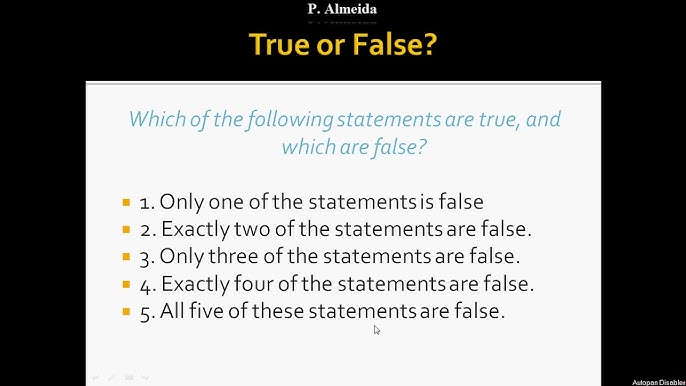
In an age of information overload, every day brings claims, numbers, and headlines that beg to be trusted. A simple question can cut through noise: which of the following statements is true? This article offers a practical framework for evaluating statements quickly, without sacrificing accuracy or time. By applying four core checks—source credibility, evidence quality, logical coherence, and reproducibility—you can navigate media, blogs, and academic writing with greater confidence. The goal is not to win an argument, but to uncover what’s most likely accurate given the available information.
Source credibility: who is speaking?
The first test is the author and the publication. Ask who created the content, what their qualifications are, and whether the outlet has a reputation for accuracy. Look for transparent authorship, dates, affiliations, and a track record of corrections when errors are identified. If any of these elements are missing, treat the claim with caution and seek corroborating sources before accepting it as truth. In practice, you’ll frequently encounter multiple versions of a claim online; weighing the source helps you decide which version deserves your attention.
Additionally, examine the domain and its editorial standards. Is the site drawn from a reputable institution, a recognized media outlet, or a marketing platform that benefits from engagement? Disclosures of sponsorships or conflicts of interest are good signs, while vague or hidden sponsorships should raise a red flag. A credible statement typically comes with clear attribution and a transparent purpose.
Evidence quality: what supports the claim?
Quality evidence is specific, verifiable, and relevant. Prefer primary data, peer-reviewed studies, or official statistics over anecdotes or marketing blurbs. When data are presented, check for sample size, methodology, margin of error, and whether the results have been replicated. If figures are missing or vague, the claim is likely weaker than it appears on the surface. Look for links to sources, lockdowns on puffery, and whether the evidence directly addresses the claim rather than tangential ideas.
In addition, assess whether the evidence has been interpreted correctly. Are there alternative explanations that the author didn’t consider? Are charts simplified to look compelling while omitting important caveats? A strong claim typically acknowledges limitations and presents a balanced view rather than a single, sensational takeaway.
Logical coherence: does it follow?
A true statement should follow a logical path from premises to conclusion. Watch for logical fallacies such as non sequiturs, cherry-picking, or false equivalences. If the argument hinges on a single source or a dramatic but unverified claim, it’s wise to pause and search for additional perspectives. In many cases, asking a few clarifying questions will reveal gaps in reasoning that reveal truth or falsehood. A carefully constructed argument will connect each step to the evidence and explain why alternative interpretations were considered and addressed.
Another practical test is to restate the claim in your own words and map it to the supporting evidence. If the rewritten version omits key details or contradicts the cited data, that’s a cue to investigate further before accepting the statement as true.
Reproducibility and consensus: can others verify?
Reproducibility matters in science and in credible journalism. Can the study be repeated with the same methods and get similar results? Is there a broad consensus among experts, or do opinions split widely? When multiple independent sources converge on a conclusion, the likelihood that the statement is true increases substantially. Beware claims that cite a single sensational source without independent confirmation. Meta-analyses and systematic reviews offer a stronger foundation than isolated experiments or isolated quotes.
Consider also the real-world applicability. Some findings are context-bound or time-limited; others demonstrate enduring principles. The more robust the reproducibility and the wider the expert consensus, the more trustworthy the claim tends to be.
Putting it together: a quick evaluation checklist
Use a simple quick-check: Who says it? What supports it? Does the argument hold up under scrutiny? Is there independent verification? When you answer these questions, you’ll have a strong basis to decide whether a claim is credible. Remember, the presence of a bold statement does not equal truth, but a transparent, well-sourced argument often does. Building a habit of these checks will improve both your critical thinking and your writing about complex topics.
For more curated reading on critical thinking and fact-checking, visit the Readisave homepage.