
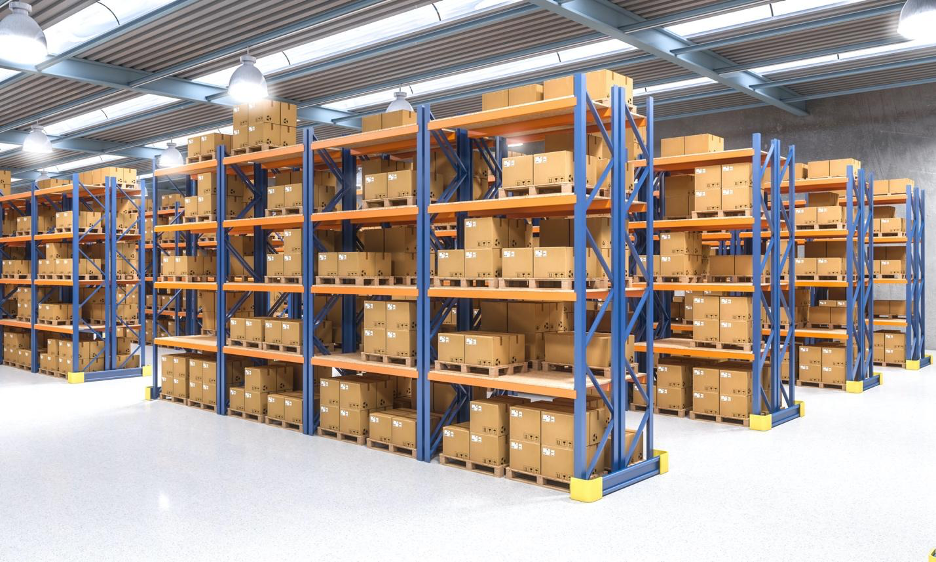
Selective pallet racking
Selective pallet racking remains the most common rack system in warehouses due to its straightforward design and broad compatibility with a wide range of pallet sizes and handling equipment. It provides full access to every pallet position, which simplifies picking and replenishment. Beam heights are easily adjustable, and bays can be reconfigured or expanded as stock or product lines change. This flexibility is especially valuable for e-commerce, multi-SKU operations, and facilities that experience frequent layout changes. The system offers a balanced mix of accessibility, cost, and scalability, making it an all-around solid choice for many operations.
Drive-in and drive-thru racking
These high-density systems store pallets directly on rails that run deep behind aisles. Drive-in racking allows forklifts to enter the storage lane from one end, while drive-thru racking provides access from both ends. They dramatically increase cubic storage density but limit access to inner pallets and can complicate picking workflows. They work best for single-SKU or low-SKU mixes with stable demand, long shelf lives, and limited replenishment. They are often favored in cold storage, seasonal goods, or bulk-item facilities where space is at a premium but frequent SKU variety is not required on every pick.
Push-back racking
Push-back racks store pallets on inclined rails so new pallets push the previous ones back deeper into the lane. This creates multiple pallet depths in each bay while still offering access to each pallet from the front. It’s a strong compromise between density and accessibility and suits moderate SKU variety with predictable demand. Maintenance is higher than a standard selective system, and forklift handling requires careful operation to avoid pallet misalignment. Push-back is popular for warehouses that want more storage density without sacrificing too much pick speed for common SKUs.
Pallet flow racking
Pallet flow racks use gravity-fed rollers to move pallets from a loading aisle to a pick face, delivering first-in, first-out rotation. These systems deliver excellent throughput and stock rotation for high-turnover products. They demand precise SKU coding and reliable pallet quality, since jams can disrupt an entire lane. While the upfront cost and installation are higher, the long-term benefits for peak pick rates can be substantial, especially in distribution centers with a stable product mix and frequent replenishment cycles.
Cantilever racking
Cantilever racks are designed for long, bulky loads like lumber, steel bars, pipes, or oversized goods that don’t fit neatly on a standard pallet. The absence of front vertical posts makes it easy to place long items on the arms, and adjustable arms accommodate varying lengths. However, cantilever is less suited for small, uniform items and can require more floor space per unit of storage if not sized correctly. It offers exceptional versatility for growing assortments of irregular items and is a staple in metal, building materials, and furniture warehouses where flexibility matters most.
To explore this topic further, you can read the detailed guide at 5 industrial rack styles that are best suited for your warehouse/.
For more storage ideas and solutions, visit the FiyLife homepage.